
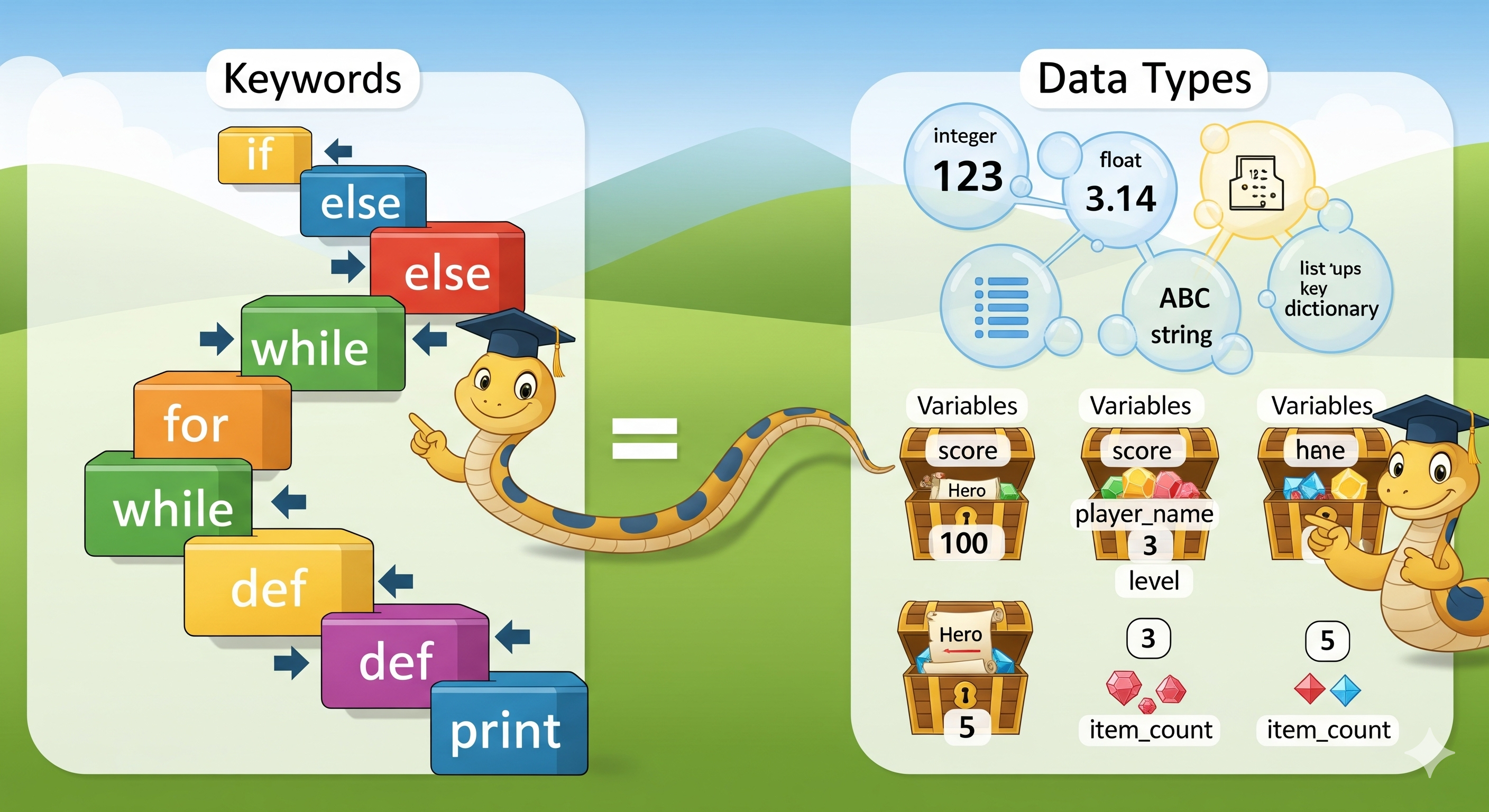
A Beginner’s Guide to Python Keywords, Variables, and Data Types
Starting your journey into the world of coding with Python is exciting! One of the first things you learn is how to speak Python’s language. And just like any language, Python has its own special vocabulary. Today, we’re going to dive into the core building blocks: keywords, variables, and data types.
Keywords: Python’s Secret Command Words
Imagine you’re giving a command to a computer. Keywords are those special, reserved words that Python already understands as commands. They’re part of the Python language itself, so you can’t use them for anything else. If you try to name a variable “for” or “if,” Python will get confused!
For example, the keyword input() tells Python, “Hey, I need the user to type something in here.” The keyword print() tells Python, “Show this information on the screen!” Keywords are the instructions that make your code work.
What’s the Difference Between a Keyword and a Regular Word?
Think of it this way:
- A regular word is any word you want to use, like a message you want to display, such as
"Hello, world!"or the name you give a variable, likemy_name. Python doesn’t have a special command for it. - A keyword is a special, reserved word that already has a specific job. You can’t change what it does.
print(),input(),if, andelseare all examples of keywords.
Variables: Your Code’s Storage Containers
So, you know how to give commands, but where do you store the information? That’s what variables are for. A variable is a container with a label you create to hold information. For example, you could have a variable named user_age to store a person’s age.
Data Types: The Kinds of Things You Can Store
What kind of stuff goes into your variable containers? That’s where data types come in. They tell Python what kind of information is being stored, which is super important because Python handles different types of data in different ways.
Here are the most common ones:
int(Integer): For whole numbers like 10, 50, or -5. No decimals!float: For numbers with a decimal point, like 3.14 or 99.9.str(String): For text, like"Hello"or"Python is fun!".bool(Boolean): For values that are eitherTrueorFalse. This is how your code makes decisions.
Putting It All Together: Type Casting
Sometimes you get data as one type, but you need it to be another. This is called type casting. The input() function, for example, always gives you text (a string). If you want to do math with a number the user typed, you have to “cast” it into an integer or a float.
You would use int() to turn a string like "15" into the number 15, so you can do things like 15 + 5.
Learning about keywords, variables, and data types is the perfect start to your coding journey. These are the fundamental building blocks of almost every Python program you’ll ever write.
HII